


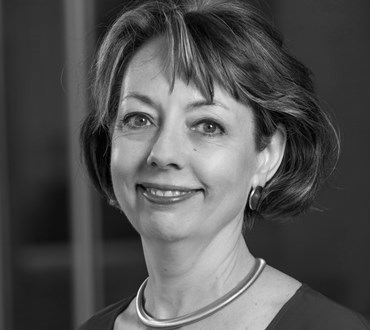
Janine R. Wedel, social anthropologist and award-winning author, is a leading scholar on shadow elites, corruption, and the role of informality and power networks in governance regimes. A Distinguished University Professor in the Schar School of Policy and Government at George Mason University, she is also a Visiting Scholar at the Institute for Futures Studies, Stockholm. She additionally has served as a Global Policy Chair at the University of Bath, UK, and a fellow at the Hertie School of Governance, Berlin.
Currently Wedel heads multidisciplinary research teams studying undue influencing, financial offshoring, and Kremlin weaponized corruption in the form of energy and information capture. These projects are funded by EU Horizon (BridgeGap), the Swedish Research Council, and the Carnegie Corporation of New York. Most recently the Guardian interviewed her for a podcast—Trump in the White House: is it time to call it corruption? – Full Story podcast—and Project Syndicate published this op-Ed she penned—"The Corruption is the Point.”
Wedel’s forthcoming (2027) Elite Influence: Everything You Need to Know, will be published by Oxford University Press. Her work has been popularized through high-impact books. Widely and favorably reviewed, they include Unaccountable: How the Establishment Corrupted Our Finances, Freedom, and Politics and Created an Outsider Class (2016); the prize-winning Shadow Elite: How the World's New Power Brokers Undermine Democracy, Government, and the Free Market (2009), which was book of the month for The Huffington Post; and Collision and Collusion: The Strange Case of Western Aid to Eastern Europe (2001), which won the Grawemeyer Award (whose previous holders include Mikhail Gorbachev and Samuel Huntington). Wedel also published Political Rigging: A Primer on Political Capture and Influence in the 21st Century (2017, with coauthors); Confronting Corruption, Building Accountability (2010, with coauthor); The Unplanned Society: Poland During and After Communism (edited, translated, annotated and introductions,1992); and The Private Poland.
A public intellectual, Wedel has testified before the OECD (Paris), Council of Europe (Strasbourg), and Congressional committees and contributed analysis pieces to more than a dozen major outlets, including the New York Times, Financial Times, Wall Street Journal Europe, Washington Post, Nation, Politico, Salon, Los Angeles Times, Boston Globe, Christian Science Monitor, USA Today, Foreign Policy, Die Blätter für Deutsche und Internationale Politik, and Project Syndicate. She was a featured columnist for The Huffington Post. She has been invited to give keynote or featured addresses at Harvard, Princeton, MIT, Chicago, Berkeley, International Political Science Association annual meeting (Brisbane), Central European University (Budapest), Freie Universität (Berlin), FLACSO Mexico University, BI Norwegian Business School, Copenhagen Business School, Warsaw University, TEDx (Berlin), among others. She has also spoken at Oxford, Yale, Columbia, Institute of Social Studies (the Hague), United Nations University (Helsinki), National Press Club, National Research Council/National Academy of Sciences, and WZB (Social Science Research Center, Berlin). Wedel’s work has been reviewed or translated into more than a dozen languages, including German, French, Polish, Russian, Italian, Spanish, Serbian, Hungarian, Danish, Mandarin, and Japanese. Wedel’s television and radio appearances include Deutsche Welle, BBC, CNN, InsideOver (Italian program), MSNBC, PBS, C-Span, and NPR.
A five-time Fulbright fellow, Wedel has also won major awards from the National Science Foundation, MacArthur Foundation, Ford Foundation, Friedrich Ebert Stiftung, and the Woodrow Wilson International Center for Scholars, among others mentioned earlier. Her work has been favorably reviewed and quoted in the New York Review of Books, Economist, New York Times, Newsweek, Financial Times, Vanity Fair, Wall Street Journal, Washington Post, Investor's Business Daily, New Republic, and Foreign Affairs, among many others. She is co–founder and past president of the Association for the Anthropology of Policy (ASAP), a section affiliated with the American Anthropological Association.


