


The Greenland Agreement of 22 September 2026
What does the agreement recently signed by Greenland, Denmark and the United States actually mean? Klaus Georg Hansen holds a PhD in Greenland’s colonial history and modern society, and below he comments on the agreement from a Greenlandic perspective. Klaus is a member of the project Indigenous self-determination and sustainable development, which was launched in Greenland at the same time as the signing of the agreement.
--------------------
On 22 September 2026, an agreement was signed at the United Nations in New York by leaders from Greenland, Denmark and the United States. At the same time, the contents of the agreement were made public. The agreement bears the anything-but-catchy title “Agreement between the Government of the Kingdom of Denmark together with Naalakkersuisut and the Government of the United States of America on the amendment of and supplement to the Agreement of 27 April 1951 pursuant to the North Atlantic Treaty between the Government of the Kingdom of Denmark and the Government of the United States of America concerning the defence of Greenland (the 1951 Defence Agreement), with subsequent relevant supplementary agreements relating thereto”.
The agreement was also immediately referred to by shortened titles such as “Agreement between Greenland, Denmark and the United States Strengthening Defence and Security in the Arctic and North Atlantic Region” and “Agreement between Greenland, Denmark and the United States”, or simply “the Greenland Agreement”. I believe that in the future the agreement will be best known as “the Greenland Agreement of 22 September 2026”.
The New Principle in US Foreign Policy
Since the contents of the agreement were made public, the press and experts and opinion-makers of every description have examined, debated and analysed it from every conceivable angle. Views on the agreement reflect, among other things, whether it is approached from the perspective of idealism or realpolitik. Overall, there appears to be a certain consensus that the agreement is “good enough” [for Denmark and Greenland] … but there has been little discussion of what, exactly, it is “good enough” in comparison with. The implicit assumption is that the agreement is preferable to the United States making good on its extraordinary threats to take control of Greenland by force if necessary.
Such a threat is in itself a wholly unreasonable starting point for negotiations on an agreement. Are we perhaps dealing here with an agreement that, as the result of a survival strategy, represents a submissive response or an adaptive, people-pleasing response on the part of Greenland and Denmark towards a large and powerful nation that does not appear willing to respect the rules of the international legal order?
For more than 200 years, Greenland has never really been able to feel entirely secure in relation to the United States, which, from the Monroe Doctrine of 1823 and the United States’ first offer to Denmark to purchase Greenland in 1832 onwards, has “always” had a particular interest in controlling Greenland. The new agreement provides Greenland with no new security in relation to the United States.
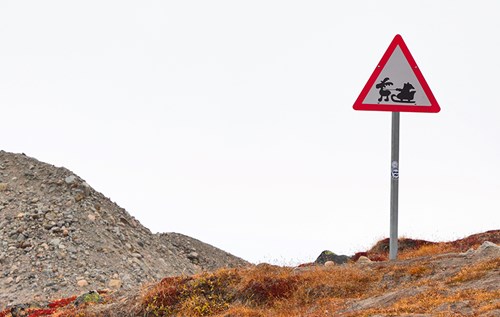 There is an expectation that there are certain specific activities that the agreement will not have influence on. The picture is taken in Kangerlussuaq by the Greenland Ice Sheet. Photo: Klaus Georg Hansen.
The doubt therefore remains at the back of many of our minds: will the United States respect the new agreement? It has often been said that Trump signs agreements in pencil, the implication being that he can quickly erase his signature again whenever it suits him. When might he decide to do that with this agreement? On this point, it is very clear that trust in the United States as a close ally pursuing a common goal is no longer present in the same way as it has otherwise been since the establishment of the UN and NATO.
What has hit Greenland so hard in this agreement is that US foreign policy during Trump’s presidency has shifted from being morally and politically driven to being transactional — in other words, governed by a “something-for-something” principle.
A Return to the Framework of the 1941 Agreement for the United States
Under the new agreement, Greenland has obtained “security”. The price Greenland is now paying for this service is that the new agreement gives the United States the freedom to do in Greenland whatever it considers necessary in order to provide that security.
The 1951 Agreement ensured that the United States had to be invited, or at the very least had to ask, before it could establish anything in Greenland. Under the new agreement, the United States no longer has to ask first or be invited. In principle, the United States can now do what it wishes without Greenland or Denmark being able to impose restrictions. In this respect, the new agreement resembles the agreement concluded in 1941. It was precisely the United States’ unrestricted access to Greenland under the 1941 Agreement that Denmark succeeded in changing in the 1951 Agreement. With the new agreement, we have returned to the principles of the 1941 Agreement regarding the United States’ freedom to operate in Greenland.
Against this background, it is hardly surprising that there are currently many different views of the new agreement in Greenland, among politicians as well as the general public. In the reactions of several people, one can sense a feeling that Greenland has been forced to choose between two evils. There has certainly been an initial sigh of relief among many people here in the country, but doubt, concern and uncertainty continue to hang like a heavy autumn fog over parts of the population.
Restrictions on Greenland’s Self-Determination
When it comes to the question of restrictions on Greenland’s self-determination, particular concern within the tourism industry and among other groups centres on the thirteen lines of the agreement under the heading “Foreign Direct Investment and Other Activities”. This section places restrictions on who may exercise control or influence, or have access to information, “within particularly sensitive sectors or activities in Greenlandic territory”. A central question in this connection is who defines what is meant by the phrase “particularly sensitive”. Concerns have also been expressed as to whether the United States may have some form of de facto veto in determining who is permitted to exercise control or influence or have access to information.
Much of the uncertainty and concern may be resolved, wholly or in part, when the forthcoming investment screening legislation is introduced and considered by Inatsisartut, the Parliament of Greenland. The bill is scheduled for its first reading on 10 November 2026, with its second and third readings to take place in early 2027. The revised proposal for Greenland’s investment screening legislation has not yet been made public by Naalakkersuisut, the Government of Greenland.
One example of the immediate uncertainty and concern can be found in Ilulissat. Tourism in Ilulissat is currently booming. In a few months, the new international airport in Ilulissat will open, providing a gateway to the Ilulissat Icefjord, which was inscribed on UNESCO’s World Heritage List in 2004. Concrete negotiations are currently under way with tour operators in China and India that would like to cooperate with Greenlandic tourism businesses to bring larger numbers of Chinese and Indian tourists to Greenland. But could the new agreement end up becoming an obstacle to this?
Another example of the current uncertainty concerns the exploitation of our mineral resources. To what extent might the new agreement, in practice, prove to restrict Greenlandic aspirations and interests concerning the exploitation (or not) of our mineral resources?
At present, it appears that much will have to be tested in practice before we can see to what extent the new agreement may affect Greenland’s scope for self-determination in the years ahead.
Klaus Georg Hansen
September, 27th, 2026, Greenland
Klaus Georg Hansen is a filmmaker, consultant, and researcher. He has a PhD in Planning and Anthropology specialised in the relationship between Greenland and Denmark, the colonial history of Greenland, and Greenlandic visions for the future of Greenland.


