


Ghost workers step out of the shadows in artistic research project
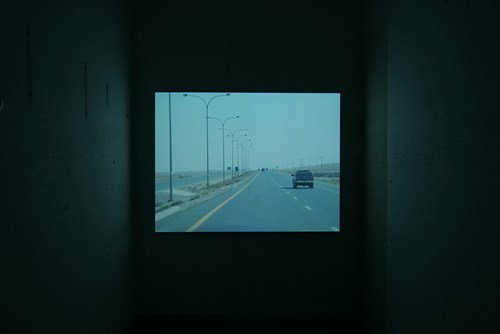
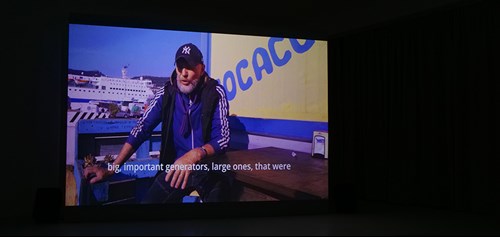
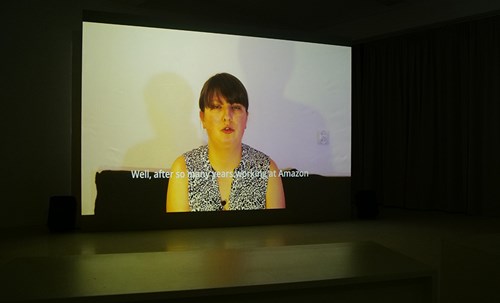
At the turn of the year, video clips were shown on a large screen at Hägersten Civic Centre in Stockholm. Warehouse workers in Poland, dockworkers in Italy, a bicycle courier in Sweden, a truck driver in Jordan, workers at data centres in the United States, and many others appeared on screen. They spoke about their working conditions, showed what they see in their workplaces, and pointed out details in their surroundings. The videos also included footage from a trade fair where vendors presented a future shaped by new machinery for handling goods in transit – technology designed to assist or replace the people featured in the films.
The continuous stream of video clips represents only a small portion of the material that people have uploaded to a digital platform documenting today’s transport sector – everything that happens between the moment we click “buy” in an app and the moment our order arrives at our door. This work is often referred to as ghost work because it is carried out by people who remain largely invisible to the public.
In 2022, Benjamin Gerdes launched the artistic research project Ghost Platform to create a digital space where artists and workers could share their experiences of this ghost work without oversight from employers. Over the course of the project, people from across the transport chain submitted contributions from Jordan, Spain, Italy, the United States, Ireland, Sweden and Poland. Depending on their opportunities to document conditions on site, the contributions took the form of videos, photographs and audio recordings – many, many hours of material.
How did you reach all the people who contributed their stories?
“We presented the project in both artistic and academic contexts and spent much of the first year establishing new contacts and encouraging people to take part. Through previous projects, I had also come into contact with people in the logistics sector who were able to share the invitation further. In some places, people had negative experiences of journalists, or of documentary filmmakers who came in and put them on display without giving them a voice, and so on. So part of the work also involved earning people’s trust and making it clear that we were interested in what they, specifically, had to say, and that they themselves would be able to control how their material was distributed.
In some places, we were helped by the fact that people working in these professions can have very different backgrounds – they might be warehouse workers with advanced degrees and art-school training, or people with a strong commitment to social issues. Since the project was planned during the pandemic, we had to assume that people would be able to create material themselves. But later on, I was also invited to film in certain places. In the end, I probably account for about half of the video material myself. At some workplaces, we were also helped by researchers with interests similar to ours, who were able to gain access and speak with the people we wanted to reach.

Did you get a sense of why those who took part wanted to be involved?
“There was a strong desire to show their workplaces and to open up a public discussion about current working conditions. In some cases, people also wanted to talk about changes they had noticed in their industry locally, which they felt no one was discussing. Overall, they wanted to add nuance to the picture of reality presented by other actors in society. Once they had shared their own material, there was also an interest in seeing material from colleagues in the industry, to understand whether others shared their experiences. They were less interested in how the material would later be presented in an artistic context, and I did not try to impose my artistic vision on them either – I just let the orchestra play!”
Looking at all the material that has been collected, how do you view the working conditions of these ghost workers?
“In one sense, they are similar in that they are all cogs in this vast machinery. But there are also major differences between occupational groups. The biggest divide is probably between those who work in ports and those who work in warehouses. Dockworkers are still workers, of course, but nowadays they are generally quite well paid. They are distinctive in having a very international outlook. They often serve as the link between one country and many others and may be in contact with colleagues in ports around the world. They have also come to realise that they hold a certain amount of power – if they take a moral stand on an issue, they can actually make a difference because they occupy such a critical position in the transport chain.
The working conditions of warehouse workers are completely different. Things are somewhat better now, but in some places it still amounts to outright exploitation. This is especially true in Spain and Italy, where many migrant workers are not fully aware of their rights. As for Amazon warehouses, the reports we have received suggest that conditions are only getting worse. People are becoming increasingly worn down physically.
More generally, it seems that things have become more difficult in many parts of the sector over the past 10–15 years. New lines of conflict have emerged, partly as a result of the privatisation of different parts of the industry. Many workers are aware of what is happening, are trying to take action, and are keeping in touch with colleagues in other countries. But organising can be difficult – not only because trade union membership can sometimes carry risks, but also because it is hard to unite different categories of workers under the same union banner. Even bringing together dockworkers and truck drivers has proved difficult because they face such different challenges, and trying to cooperate internationally is even more challenging.”
In an earlier interview, you noted that the transport sector changed even during the course of this project. In what way?
“When we started the project, the focus was on the transition from the pandemic to the post-pandemic period. Would people’s new habits around transport and consumption persist, or would they change? But as the project progressed, I was reminded of the history of container shipping and the military role it has played ever since the Vietnam War. That role has really regained importance during the lifetime of this project. As a result, the project’s focus has partly shifted from documenting everyday consumer logistics to documenting the movement of weapons. What impact this will have on infrastructure in the future, and on the people who work within it, remains to be seen.”
If you were to start the project again today, what would you do differently?
“One thing we did not do this time, but which would be both interesting and particularly well suited to artistic methods, would be to reflect more creatively on what a fairer and more sustainable future might look like. Once again, I would want to involve the people who actually work in the sector and ask them what could be done differently. What would a better future look like from a workplace perspective? Robots – could they be a good thing, and if so, how? How could the system function in a more sustainable way?
The images we are shown come from employers and companies, but what do the people living the reality of work on the ground have to say? That was not our focus this time, because what we wanted to highlight were the rapid changes in working conditions that are taking place across the sector right now.”
Any other reflections?
“It is always interesting to discover where the gaps in knowledge lie. You can make assumptions about other people because they belong to a particular group, only to realise that you have more in common than you thought. It was rewarding to see that the contributors wanted to connect with one another and found value in doing so. I became a kind of facilitator and ended up playing a more active role in that process than I had expected.
Speaking of facilitating connections within the project, I was able to introduce some of the contributors from Jordan to one of my research colleagues here at the Institute for Futures Studies when they visited Stockholm. They knew that the Swedish International Development Cooperation Agency (Sida) had supported several valuable projects in their region and were given the opportunity to meet Göran Holmkvist, who was at the institute at the time and had worked extensively on development cooperation issues. It was a form of value creation that simply could not have been anticipated.”
The project has received a communications grant to help disseminate its results more widely during 2026. Congratulations! What happens next?
“Thank you – it’s really exciting! We now have all this material and are very keen to report back to the people who contributed. So far, we have mainly presented the material in artistic and academic contexts. For that reason, we have decided to organise four exhibitions, combined with public conversations and digital tools that will make the results accessible to a wider audience.
The exhibitions will be held in Sweden, Italy, Spain and the United Kingdom. We are currently in discussions with film festivals, museums and similar organisations to determine the exact venues and dates. Since it was very important to participants that the project reach beyond the traditional art audience, our hope is that these activities will engage a broader public and, ideally, spark interest among policymakers and civil society organisations.”
Interview by Erika Karlsson


