


elevate
Unemployment more important than immigration status for risk of divorce
The elevated risk of divorce among certain immigrant groups can be explained by socioeconomic factors. Stress due to immigration status does not seem to elevate the risk for divorce. These are some of
Declining willingness to fight for one’s country: The individual-level basis of the long peace
Journal of Peace Research, vol. 52, no. 4, p. 418-434. Abstract The Democratic Peace thesis suggests that the absence of war between major powers since 1945 is caused by the spread of democracy. The
Explaining health disparities between heterosexual and LGB adolescents by integrating the minority stress and psychological mediation frameworks: Findings from the TRAILS study
Journal of Youth and Adolescence, 49(9), 1767–1782. https://link.springer.com/article/10.1007%2Fs10964-020-01206-0 Abstract Lesbian, gay, and bisexual (LGB) adolescents experience elevated levels of inteN
School Contextual Features of Social Disorder and Mental Health Complaints - A Multilevel Analysis of Swedish Sixth-Grade Students
Int. J. Environ. Res. Public Health 2018, 15(1), 156; doi:10.3390/ijerph15010156 Abstract This study addressed school-contextual features of social disorder in relation to sixth-grade students’ experienc
Disparities in depressive symptoms between heterosexual and lesbian, gay, and bisexual youth in a Dutch cohort: The TRAILS Study
Journal of Youth and Adolescence, 45(3), 440-456. doi.org/10.1007/s10964-015-0403-0 Abstract Lesbian, gay, and bisexual (LGB) youth experience elevated levels of depressive symptoms compared to heterosexu
Two Decades of Same-Sex Marriage in Sweden: A Demographic Account of Developments in Marriage, Childbearing, and Divorce
Demography 57, 147-169 Abstract In this study, we provide demographic insight into the still relatively new family form of same-sex marriage. We focus on period trends in same-sex marriage formation and
The Time of Perils and a World System of Governance
Institute for Futures Studies. Working paper 2025:1 Abstract Extinction risk refers to the possibility of the extinction of the human species, and is the subject of a growing field of study. In this con We present here an argument in favor of the time of perils hypothesis. We argue that, according to several prominent theories in the field of international relations (IR), humanity (absent an extinction event) is likely to be unified under a world system of governance. By a “world system of governance” (WSG), we mean a global set of institutions, norms and structures that can settle disputes, promote trust and cooperation, and reduce great power security competetion. We explore the most prominent theories in international relations, which include: realism, liberalism and constructivism, and how these theories propose the emergence of a global system of governance. We conclude that a WSG will, if it emerges, have a significant impact on reducing extinction risk, including risks from emerging technologies, biorisk and non-anthropogenic risks. This argument, linking IR theory to existential risk is, to our knowledge, novel and potentially significant in the context of ascertaining whether existential risk prevention has astronomical value in expectation due to the vast number of potential lives that could exist in the future.
What to lobby on? Explaining Why Large American Firms Lobby on the Same or Different Issues
Business and Politics Abstract What determines whether or not firms lobby on the same policy issues? Scholars offer two broad answers to this question. Firms that are (1) similar or (2) connected throug
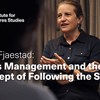
Maja Fjaestad: Crises management and the concept of “following science”
Maja Fjaestad was state secretary for health in Sweden during the Covid 19 pandemic. Recently she published the book (with Emma Lennartsson) “Mitt i krisen” (In the Midst of the Crisis) (Volante, 2024

Research seminar with Maja Fjaestad: Post-pandemic reflections on leadership and preparedness: Crises management and the concept of “following science”
Venue: Institutet för framtidsstudier, Holländargatan 13, 4th floor, Stockholm, or online.Research seminar with Maja Fjaestad, IFFS researcher, expert coordinator at the Center for Health Crises at KI


