


unified

Ambivalence: A new unified theory about its nature, grounds, and application to normative conflicts
Having mixed feelings about something can help us to deal with conflicts. Since this view on ambivalence challenges traditional approaches that see ambivalence as a flaw, this project aims to develop a new theory of ambivalence.
Vito Peragine: Measuring inequality and welfare when some inequalities matter more than others
Venue: Institute for Futures Studies, Holländargatan 13 in Stockholm, or online. Research seminar with Vito Peragine, Professor of Economics at the University of Bari. His work spans the area of public
Research seminar with Anders Sandberg: Serf’s Up: Law, AI, Singletons and Leviathan
Venue: Institutet för framtidsstudier, Holländargatan 13, StockholmRegister hereWelcome to this research seminar with Anders Sandberg, Ph.D. in computational neuroscience, researcher at IFFS and Senior
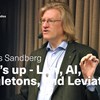
Anders Sandberg: Serf's up - Law, AI, Singletons and Leviathan
Research seminar with Anders Sandberg, Ph.D. in computational neuroscience, researcher at IFFS and Senior Research Fellow at the Future of Humanity Institute, Oxford University. Abstract A key problem
Interdisciplinary workshop: Contemporary perspectives on conservatism
Conservatism as a distinctive political ideology was born out of Edmund Burke’s critique of the French revolution. Despite its significant influence in society and research, there exists no unified un
Comparing and modeling the use of online recommender systems
Computers in Human Behavior Reports, vol 15 Abstract This study explores a new way to model the adoption of AI, specifically online recommender systems. It aims to find factors that can explain the varia
The Time of Perils and a World System of Governance
Institute for Futures Studies. Working paper 2025:1 Abstract Extinction risk refers to the possibility of the extinction of the human species, and is the subject of a growing field of study. In this con We present here an argument in favor of the time of perils hypothesis. We argue that, according to several prominent theories in the field of international relations (IR), humanity (absent an extinction event) is likely to be unified under a world system of governance. By a “world system of governance” (WSG), we mean a global set of institutions, norms and structures that can settle disputes, promote trust and cooperation, and reduce great power security competetion. We explore the most prominent theories in international relations, which include: realism, liberalism and constructivism, and how these theories propose the emergence of a global system of governance. We conclude that a WSG will, if it emerges, have a significant impact on reducing extinction risk, including risks from emerging technologies, biorisk and non-anthropogenic risks. This argument, linking IR theory to existential risk is, to our knowledge, novel and potentially significant in the context of ascertaining whether existential risk prevention has astronomical value in expectation due to the vast number of potential lives that could exist in the future.


